Gag Order
Of Fates & Fables (The Complete Series)The Gag Order is a magical restraint that makes its subject unable to speak about the matters it covers. Rather than functioning as a literal gag, it works through dark magic infused into a tattoo: Justice tries to answer questions, but the effort leaves him sweating, frustrated, and finally exhausted. Its discovery shifts the problem facing Kash Montgomery’s group from extracting information to identifying the magic that has made disclosure impossible.
Recognition and Discovery
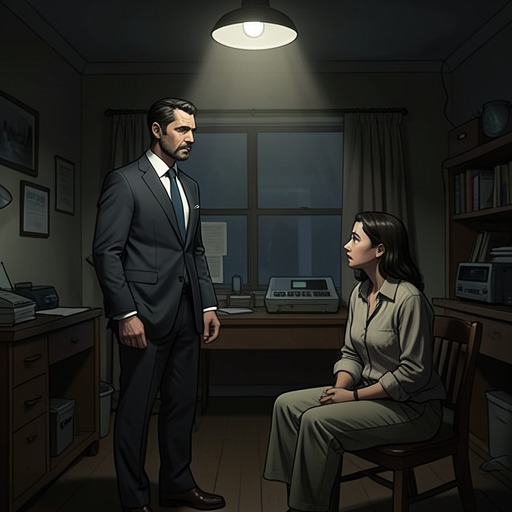
The Gag Order comes into focus during an interrogation of Justice. As Kash Montgomery questions him, Justice opens his mouth without producing a sound. Sweat runs down his brow; he shakes his head, clenches his teeth, and eventually collapses against the cushions, drained. Romy Cartelli tells Kash to stop before he kills Justice, pointing out that he cannot answer and that they must work with what she knows. The scene presents the silence not as unwillingness or defiance but as an imposed limit with an immediate physical cost.
Lynch connects Justice’s condition to the gag order placed on their previous prisoner. Romy confirms the connection, but admits that she does not know whether the magic can be broken. Her description makes the restriction broad: the affected prisoners cannot talk about any of it. The uncertainty matters. The group can recognize that speech has been blocked without knowing how to remove the block, so the interrogation cannot simply proceed through greater pressure or more questions.
Magical Mechanism and Physical Sign
The characters initially have only the symptom—the inability to speak—and must reason toward a cause. Lynch proposes dark magic as the explanation. Kash doubts that possibility would be sufficient without some physical manifestation, framing the search as a question of how the spell is anchored rather than merely what it does. Justice then stands, lifts the blanket, and exposes a tattoo wrapped around one ankle. His attempt to explain still fails; Romy identifies the tattoo as the place where the magic is infused.
That revelation gives the Gag Order a visible, bodily form. The restraint is not shown as an abstract rule imposed by conversation alone: a mark on Justice’s skin bears the magic that prevents his speech. The tattoo provides evidence for the spell’s operation, but the scene does not establish a way to remove or break it. Recognition of the mechanism therefore advances the group’s understanding without immediately restoring Justice’s ability to testify.
Effects on Testimony and Interrogation
The Gag Order obstructs more than one exchange. Lynch’s reference to a previous prisoner indicates that the problem has recurred, while Romy’s explanation suggests that those affected share the same inability to discuss the covered matters. The restriction frustrates the group’s effort to learn what has happened and what Justice knows; pressing him only exposes how completely the spell prevents an answer. His visible distress also makes the cost of questioning him plain, prompting Romy to intervene on his behalf.
The surrounding interrogation scenes clarify the importance of information about Brody’s operation without proving that every unanswered question falls under the spell. In a recording, Justice urges Conner to reveal where the girls are, while Conner calls Justice a sellout and warns that Brody will make an example of him. Later, Conner refuses to give information even if he has it. These exchanges distinguish ordinary refusal from Justice’s magically enforced silence: Conner can speak and choose what to reveal, whereas Justice’s effort to answer is visibly arrested. The Gag Order thus creates an evidentiary obstacle, not simply another name for a prisoner’s unwillingness to cooperate.
Significance
The Gag Order makes control legible through the contrast between speech and its forced absence. Justice has something the others want to hear, but his body cannot turn it into words; the effort exhausts him before it produces testimony. The tattoo’s disclosure makes that silence traceable to dark magic, while leaving the practical question of how to undo it unresolved in the scene.
The rule also belongs to a broader pattern of coercion surrounding Brody. Romy later confronts Brody over what he is doing, and Missy describes how his insults became threats when she refused to let him turn her. Kaitlyn likewise insists that the harm done to her and the other captive women must not be forgotten, even as she makes the best of her circumstances. Those events are not identified as consequences of the Gag Order, but they place magical silencing within a story where threats and imposed control also restrict people’s choices. The spell’s distinctive force is that it can prevent testimony at the point when testimony is needed, leaving its victims present but unable to explain what has been done.